1 / 4Local calibration
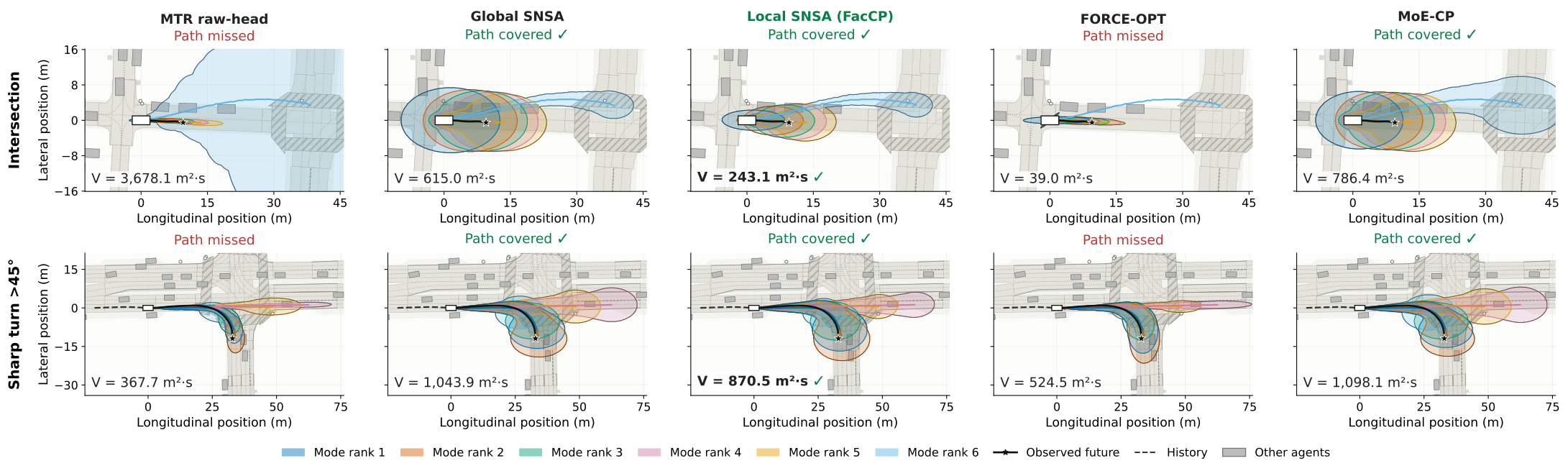
Estimating a separate calibration threshold near each query can leave too few relevant examples, especially in high dimensions. Changing the threshold also cannot recover a shape that the chosen score cannot express. FacCP uses local residuals, the predictor’s errors, to build the shape, then uses the entire calibration sample to choose one global inflation threshold.
2 / 4Scalar-score rectification
PIT-CP and Rectified CP adjust a chosen scalar score to improve local coverage. But once a score has discarded direction or multiple possible outcomes, adjusting that number cannot bring them back. Rescaling a distance-based ball, for example, cannot turn it into a tilted ellipsoid. FacCP learns the residual distribution and constructs the geometry before reducing it to a score.
3 / 4Localized scores · SLCP
SLCP adapts a chosen scalar-score distribution using nearby examples, but its neighborhoods depend on the chosen features and kernel. Irrelevant features can obscure which examples share the same uncertainty, while scalar scores cannot recover geometry they discard. FacCP explicitly learns a space for retrieving similar multivariate errors, adapting the set’s shape before reducing it to a score.
4 / 4Set-specific learning
Learning geometry directly can tie the model to one set family and be data- and parameter-inefficient for high-dimensional structured outputs. FacCP retrieves a residual distribution instead: one learned representation supports ellipsoids, hyperboxes, zonotopes, and density-based sets without retraining, with separate conformal calibration for each constructor. This reuse is especially useful when training data or model capacity is limited.